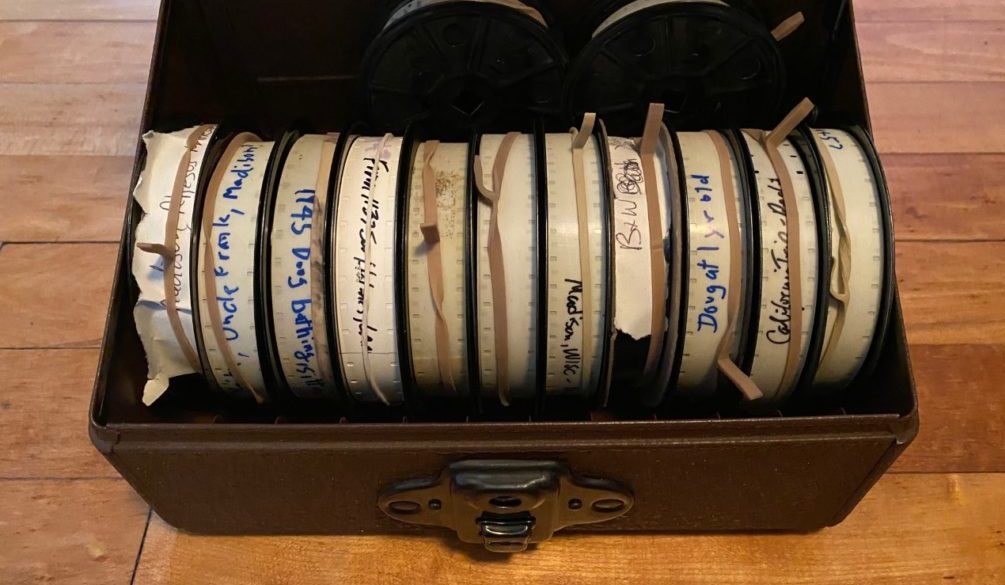
ABOUT THE FORMAT
The earliest formats of motion picture film were introduced in the late 1890s. The most popular gauge, or width, of motion picture film at that time was 35mm film. Early Thomas Edison camera tests of moving images were filmed in 1891, and Edison and his employee, William Kennedy Dickson, released the short black and white silent film Blacksmith Scene (1893), ushering in the age of silent film. The film Workers Leaving the Lumière Factory in Lyon (1895) is widely regarded as the first documentary motion picture ever made.
During these early years of movie-making, 35mm film was made with a cellulose nitrate base, which was highly flammable. In 1923, Eastman Kodak produced the first 16mm “outfit”, consisting of a camera, projector, tripod, screen and splicer for $335¹. Intended as an amateur alternative to the conventional 35mm format, the film measured 16 millimeters wide and sported a frame one-fourth that of 35mm film². The base for 16mm film was made of cellulose acetate, and was referred to as “safety film”. Unlike nitrate, which could produce its own oxygen even when immersed in water, acetate film was not combustible.
Motion picture film is unique among moving image AV formats. Unlike videotape, a playback deck is not required to determine content. A title screen may appear at the beginning, production credits may appear at the end. Intertitles may show throughout the film, and the appearance of a certain type of vehicle, for example, may help narrow down the year the movie was filmed. However without a projector, film editing table, or other means of playback, film can only be viewed frame for frame, which can make further determination of context difficult.
ASSESSING THE FORMAT
Making an assessment of the condition of motion picture film requires a number of factors. As the acetate base of film breaks down, it gives off a vinegary scent, often referred to as “vinegar syndrome”. While this process cannot be stopped, it can be slowed down if film is stored under ideal conditions. The Preservation Self-Assessment Program (PSAP) at the University of Illinois Urbana-Champaign lists ideal storage conditions for motion picture film at 0-32° Fahrenheit and acceptable conditions at 33-54°, with a relative humidity of 30-50% (allowing a fluctuation of ±2°F and ±5% RH).
TREATMENT
Preservation steps should be taken prior to scanning motion picture film. In order to measure how much acetate breakdown has occurred, an acetate decay (AD) strip may be placed inside the film can with the reel of film. After a certain length of time (depending on the current storage conditions of the film), the strip will change colors depending on the level of vinegar syndrome the film is experiencing. The strips and a color-reference pencil (supplied by the Image Permanence Institute) help to measure how much acetate deterioration has occurred in the film.
Once the level of acetate decay has been determined, the film must be rehoused. Reels of 16mm film often arrive at an archive on metal or plastic reels, and in metal or plastic film cans. Broken sprocket holes may be repaired with small pieces of perforated 16mm film splicing tape. The film must be moved from their original reels onto 3” archival cores, and cleaned with a film cleaner and clean cloth. Opaque film leader must be spliced onto the beginning and end of the reel. Film leader protects the moving image content, allows for a written description of the film to be written on the leader, and provides additional length of non-image film to be threaded through the film prior to moving images passing over the scanner’s lens. Once scanning and rewinding have been completed, the loose end of the film should be taped down and the film should be rehoused in a vented archival can. The size of the can should be close enough to the size of the film reel so that the film does not have too much room to slide around in the can. Finally, the film container should be clearly labeled to include the film number, collection number with descriptive title, accession number, month and year of digitization, and the digital object ID number.
PLAYBACK
(Just an example, copy/pasted from B&H) The Blackmagic Design Cintel Scanner 2 with 35mm Gate is a self-contained 35mm film scanner that interfaces with DaVinci Resolve. It features a removable precision mechanical film gate, sticky rollers, optics, a high-intensity diffuse light source, and sensor. It is designed with an architectural aesthetic that allows it to neatly fit into most environments, yet takes up only a fraction of the size of a traditional telecine machine.
The Cintel scanner will scan negative and positive 35mm film into HD quality for instant preview of your 4K scans. This is the second generation of the scanner, which replaces the original scanner’s Thunderbolt 2 port with a Thunderbolt 3 port, as well as PCIe connection. The scanner is constructed using aircraft design techniques for a stiff and vibration-free main deck, so you get smooth film handling. The Cintel Scanner includes a 35mm film gate, film spools, a set of four cleaning rollers, desk mount feet, and DaVinci Resolve Studio software. The scanner interfaces directly with DaVinci Resolve, which gives you the power to edit film rolls back together, and scans to be color-graded, reframed, noise-reduced, and audio-extracted. An optional 16mm gate and audio/keycode reader expands the capabilities of your scanner.
STORAGE
Stored flat in vented cans at a temperature between 2°C (35°F) and 13°C (55°F) and a relative humidity between 30 and 35 percent are excellent conditions for long-term storage of negatives.
OUR COLLECTION
The bulk of the 16mm film collections in the University Archives is Spartan athletics, primarily basketball and football. Highlight reels of other sports including swimming and diving, hockey, golf, and tennis (among others) are included in the collections of filmed athletic events. In September 2017, University Archives (in an agreement with MSU Athletics) acquired a motion picture film scanner, allowing for the in-house digitization of 35mm and 16mm motion picture film. Spartan basketball films were the first to be reformatted, in order to prepare footage for display monitors in the Tom Izzo Basketball Hall of History, in the new Gilbert Pavilion expansion of the Breslin Center.
The film collection contains archival footage relating to local and state historical events, the history of agriculture, home economics, and education, MSU international projects, and sporting events especially varsity college football³. The films date from the 1920s (16mm film transfers of original 35mm REO-Grams newsreel films, now lost due to advanced breakdown in the nitrate film base) through the 1980s. Currently, the collections number over 4000 reels, and are in danger of being lost forever due to slow, inevitable decay. The images on these reels contain the earliest moving image recordings in Michigan State University’s history, and steps must be taken to ensure their long-term preservation.
CITATIONS
- Kattelle, Alan (2000). Home Movies: A History of the American Industry, 1897–1979. Transition Publishing. p. 334.
- Eisloeffel, Paul (2013). “16mm Format History”. http://www.archivesfilmworks.com/uploads/1/2/5/3/12531554/16mm_format_history_v2.pdf
- Motion Picture Film Project – Initial Report (author unknown), MSU Archives (1988), p. 2